
Services

Twelve disciplines, one delivery team

Hitch and Hike covers the full path from an unclear problem to a maintained production system. Each service below explains what it is, the problems it addresses, what you receive, and how we approach the work.

Flat-lay of a laptop displaying code beside a notebook containing hand-drawn interface wireframes

Project delivery

A defined scope and outcome, delivered end to end by our team.

Team extension

Our engineers work inside your existing team and process.

Advisory

Time-boxed review, architecture guidance or a second opinion.

Ongoing support

Continuous maintenance and improvement of a live system.

Detailed service descriptions

01

Custom software development

Purpose-built applications for a workflow that off-the-shelf products cannot express without heavy compromise.

Problems addressed

Processes stitched together from spreadsheets and email, licence costs for features nobody uses, and rules the business depends on that no product supports.

Typical deliverables

  • Domain model and architecture document
  • Working application in a production environment
  • Automated test suite and CI pipeline
  • Operational runbook and handover session

Our approach

We model the domain before writing feature code, keep business rules in one place rather than scattered across the interface, and release in increments so the first useful version arrives early.

02

Web application development

Browser-based products, from customer-facing platforms to internal tools used all day by a small number of people.

Problems addressed

Pages that slow to a crawl as data grows, interfaces that fail on mobile, and front-ends so tangled that small changes carry large risk.

Typical deliverables

  • Component library tied to a design system
  • Server-rendered pages where search visibility matters
  • Accessibility review against WCAG guidance
  • Performance budget and measurement setup

Our approach

Rendering strategy is chosen per page rather than site-wide. State is kept close to where it is used, and we test the interface with realistic data volumes rather than tidy samples.

03

Mobile product development

Applications for iOS and Android, built natively or with a shared codebase depending on what the product actually needs.

Problems addressed

Poor behaviour on weak connections, features that drain battery, review rejections and release processes that block urgent fixes.

Typical deliverables

  • Store-ready builds for both platforms
  • Offline and synchronisation strategy
  • Crash and performance monitoring
  • Release pipeline with staged rollout

Our approach

We design for the network being unavailable, treat platform conventions as requirements rather than suggestions, and automate signing and distribution so releases are not a specialist ritual.

04

UI/UX design

Interface and interaction design grounded in the real tasks people perform, delivered as a system rather than a set of screens.

Problems addressed

High training cost for new staff, repeated user errors in the same places, and visual inconsistency that accumulates with every new feature.

Typical deliverables

  • Task flows and information architecture
  • Interactive prototypes for key journeys
  • Design system with tokens, states and rules
  • Accessibility and content guidelines

Our approach

We design with real content, define empty, loading and error states alongside the happy path, and hand over components that map one to one with what gets built.

05

Cloud solutions

Cloud architecture and migration across AWS, Google Cloud and Azure, sized and structured for the workload in front of us.

Problems addressed

Unpredictable bills, environments that drift apart, scaling problems during peaks and manual provisioning that only one person understands.

Typical deliverables

  • Infrastructure as code for every environment
  • Network, identity and access design
  • Cost model with monitoring and alerts
  • Backup, recovery and failover plan

Our approach

Nothing is configured by hand in a console. We start from the requirements for availability and recovery, then choose managed services where they reduce operational load and avoid them where they lock the design in.

06

System integration

Connecting applications, databases and third-party platforms so information moves reliably between them.

Problems addressed

Duplicate records, reconciliation done by hand, brittle point-to-point scripts and no clear owner for a given piece of data.

Typical deliverables

  • Integration architecture and data-flow map
  • Transformation and validation rules
  • Retry, idempotency and dead-letter handling
  • Monitoring for throughput and failure

Our approach

We define one source of truth per data domain, make every transfer idempotent, and assume failure is normal — the interesting design question is what happens on the second attempt.

Network cables plugged into a server switch with illuminated orange status lights

Platform work sits underneath everything else

Application code is only half of a working product. The remaining services cover the layer that decides whether the product stays available: interfaces between systems, testing, infrastructure, independent review, modernisation of what already exists, and the long support life that follows a launch.

Platform, quality and lifecycle services

07

API development

Designing and building REST, GraphQL and event-based interfaces for internal services, partners or public consumers.

Problems addressed

Undocumented endpoints, breaking changes shipped without warning, inconsistent errors and no way to control who uses what.

Typical deliverables

  • OpenAPI or GraphQL schema as the contract
  • Versioning and deprecation policy
  • Authentication, authorisation and rate limiting
  • Reference documentation with examples

Our approach

The contract is written before the implementation and reviewed by the people who will consume it. Errors follow one consistent shape, and every change is checked against compatibility rules before release.

08

Quality assurance

Test strategy and execution across unit, integration, end-to-end, performance, accessibility and security checks.

Problems addressed

Regressions found by customers, releases that need days of manual checking, and a test suite so slow or flaky that people ignore it.

Typical deliverables

  • Layered automated test suite in CI
  • Exploratory testing charters and findings
  • Load and performance test results
  • Defect triage and quality reporting

Our approach

Tests are weighted towards the fast layers and reserved at the top for the journeys that matter most. Flaky tests are treated as defects, because a suite nobody trusts provides no protection.

09

DevOps and infrastructure

Build, deployment and operations engineering: pipelines, environments, observability and incident readiness.

Problems addressed

Manual deployments, long lead times between merge and release, no visibility when something breaks and recovery plans that have never been tested.

Typical deliverables

  • CI/CD pipelines with automated gates
  • Containerised, reproducible environments
  • Logging, metrics, tracing and alerting
  • Rollback procedures and incident runbooks

Our approach

We aim for deployments that are unremarkable: small, frequent, observed and reversible. Alerts are tuned to conditions that require a human, so that a page always means something.

10

Technical consulting

Independent assessment of architecture, code, delivery practice or technology choice, with written recommendations.

Problems addressed

Uncertainty before a major investment, disagreement inside a team about direction, or a system whose real condition is unclear.

Typical deliverables

  • Architecture and code assessment report
  • Risk register with severity and effort
  • Prioritised, sequenced recommendations
  • Review workshop with the internal team

Our approach

We read the code and the telemetry, not only the diagrams, and talk to the people who operate the system. Recommendations are ordered by risk reduced per unit of effort, and we say plainly when the right answer is to change nothing.

11

Product modernisation

Bringing ageing applications up to date without stopping the business that depends on them.

Problems addressed

Unsupported runtimes, security exposure from old dependencies, rising change costs and difficulty hiring for the existing stack.

Typical deliverables

  • Modernisation roadmap with sequencing
  • Incrementally replaced modules behind stable interfaces
  • Data migration with verification steps
  • Updated build, deployment and test tooling

Our approach

We avoid full rewrites wherever an incremental path exists. Capabilities move one at a time behind an interface that hides which implementation is serving the request, so progress is continuous and reversible.

12

Maintenance and support

Ongoing care for systems in production: fixes, dependency updates, monitoring and steady improvement.

Problems addressed

Deferred updates accumulating into a large risk, no defined response path for incidents and improvements that never reach the top of the list.

Typical deliverables

  • Agreed response expectations and escalation path
  • Scheduled dependency and security updates
  • Monitoring review and capacity reporting
  • Regular small improvements alongside fixes

Our approach

Support is treated as engineering, not ticket processing. Each incident ends with a cause and a change that makes recurrence less likely, and routine maintenance is scheduled so it does not compete with feature work.

Combining services

Most engagements draw on several of these at once

A new product usually combines design, application development, API work, quality assurance and infrastructure. A modernisation programme leans on consulting, integration and support. We assemble the mix around the outcome rather than selling each discipline separately, and we will say when a piece of work is not needed.

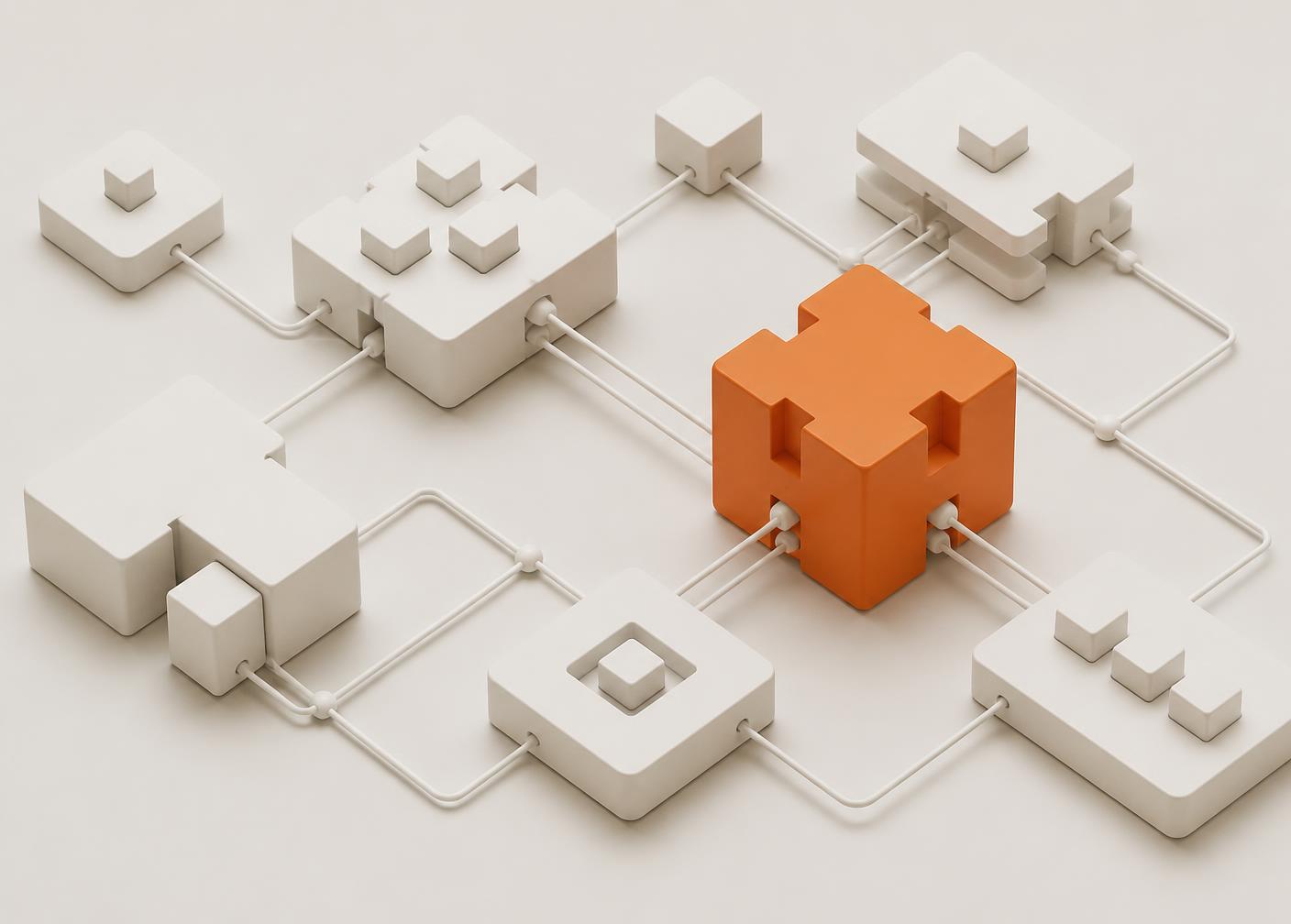
Abstract composition of connected modular blocks in white with one orange block at the centreClose-up of stacked transparent panels with a glowing orange edge, suggesting layered system architecture